
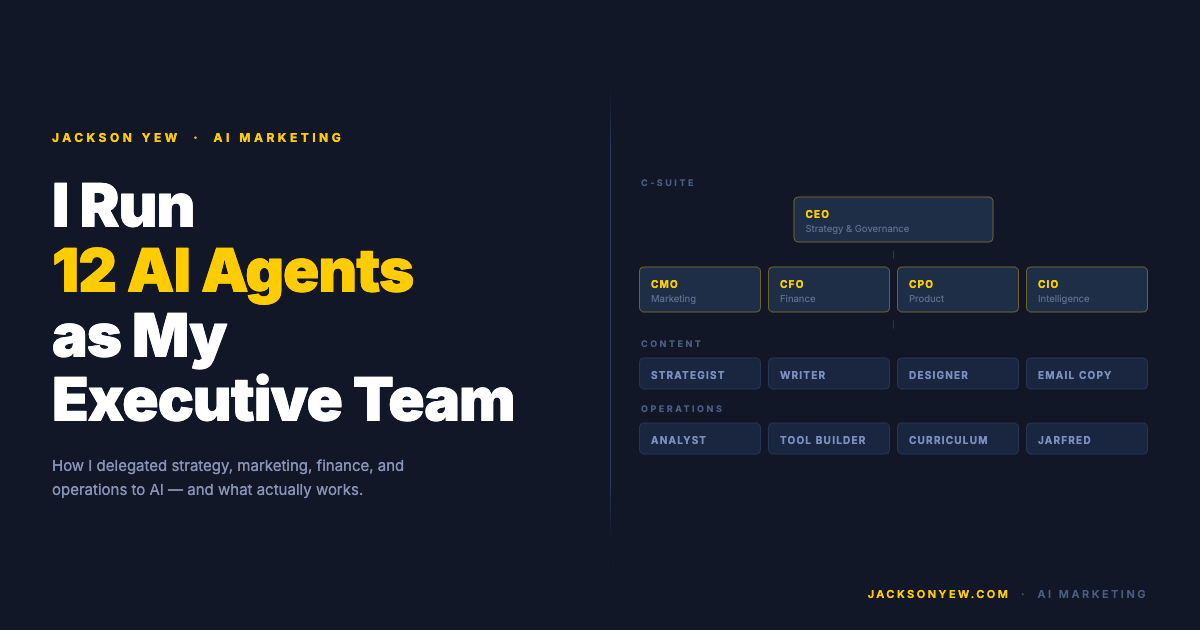
I Run 12 AI Agents as My Executive Team
I didn’t build an AI executive team because I thought it would be cool.
I built it because I was tired of being the bottleneck.
My main company has around 20 in-person team members, good margin, strong cash reserves. The business was working. The coordination overhead was killing me. Too much of my time was going to figuring out who was working on what, chasing status updates, and context-switching between too many things at once.
I was already using AI heavily. Claude Code for development work. AI tools for drafting, research, analysis. These helped me produce output faster, but even with them, I was still the relay station.
Every AI session started from scratch. No memory of what we’d been building the week before. No awareness of which tasks were still open. No continuity between sessions. The work paused the moment I closed the window. I still had to re-explain context every time, restart conversations, hold the whole picture in my head.
The bottleneck wasn’t AI capability anymore. It was me. Still the one driving everything, even with AI doing more of the work.
That’s the problem Paperclip solves. Not “can AI do this.” That was already answered. The real question: can AI work continue when you’re not watching?
Then Paperclip launched. An open source tool that lets you run a real org chart of AI agents, with budgets, job titles, task systems, and persistent memory. It gave me a different kind of lightbulb.
Here’s what I learned.
The setup
Twelve agents. CEO, CMO, CFO, CPO, CIO. Plus direct reports: Content Strategist, Content Writer, Creative Designer, Analyst, Curriculum Designer, Tool Builder.
Each agent has three files: SOUL.md (identity + decision principles), HEARTBEAT.md (daily operating checklist), and a memory system so they carry context across sessions and get better over time.
Paperclip wakes them on a schedule, assigns tasks through a shared ticket queue, lets them coordinate with each other, and keeps a full audit trail of every action and decision. Nothing disappears when I close my laptop.
The insight I didn’t expect
I assumed the hard part was AI capability. That the agents wouldn’t be smart enough to do real work.
That’s not the problem.
The problem is continuity.
Every AI tool I’d used before was stateless. You’d have a great session, close it, and tomorrow you’d start from scratch. The tool had no memory of what you were building. No context of what was already decided. Every interaction was the beginning of a conversation that was never going to finish.
Paperclip fixes continuity. Each agent has a memory system. Each task has a history. Work persists whether I’m watching or not. My CMO doesn’t need me to re-explain the content strategy every time it runs. My CFO carries context from last month’s numbers. Agents build on each other’s work.
That shift, from stateless tools to a persistent operating system, is the actual unlock. I underestimated how much it would change things going in.
What surprised me most
I expected the agents to be useful individually. I did not expect them to generate useful friction with each other.
My CMO flags things the Content Strategist missed. My CFO has questioned recommendations from the CPO. These aren’t dramatic conflicts. They’re the kind of cross-functional checks that happen in a good leadership team. One person catches what another overlooked. A different perspective surfaces a problem before it becomes a mistake.
The agents don’t just execute. They review, push back, surface tensions. That’s what makes a real executive team valuable, and I didn’t know AI agents could produce it. They do.
What actually changed in my day
Before: I’d start every week with a mental map of what everyone was working on, because nothing tracked itself. I’d field status requests. I’d unblock things that stalled because no one else could make the call. Even with AI tools helping me work faster, the coordination was still entirely manual. I was the thread that held everything together.
Now: I open a dashboard, review what moved overnight, make a few key decisions, and the execution layer continues without me.
Last week, my CMO identified a content gap, briefed the content writer, reviewed the draft, ran it through voice checks, and pushed it to our blog pipeline. By the time I saw it, the work was done and waiting for my sign-off. That sequence used to take me half a day of context-switching between Notion, drafts, and feedback loops. Now it takes ten minutes to review.
The agents flag blockers. They complete assigned work. They comment on each other’s output. Work doesn’t stop at 6pm.
The shift isn’t “AI did the thinking for me.” It’s “I’m no longer the relay station for every task.”
Most AI tools make individual tasks faster. This makes the coordination layer disappear.
What’s actually hard
Writing good personas takes real time. The SOUL.md files that define each agent’s identity, values, and decision-making principles. These aren’t templates you complete in twenty minutes. You have to think carefully about what you actually want from each role, how you want them to handle tradeoffs, what they should escalate versus decide themselves, and where the lines are. Vague personas produce vague work. The clarity you put in is the clarity you get out.
Ambiguous task definitions confuse agents, even very capable ones. The task brief is everything. If a task is poorly scoped, even the best agent will produce the wrong output. This is actually a useful forcing function: writing clear, well-defined tasks is good project management regardless of who’s doing the work.
You still review everything. I haven’t outsourced my judgment. I’ve outsourced execution and coordination. The agents flag, draft, and propose. I review and decide. Anyone expecting to fully step back will be disappointed. But the ratio shifts: what used to take hours to manage now takes minutes to review.
The business case
20+ team members. Multiple new clients onboarded every month. Real revenue, real operations.
The agents didn’t replace anyone on the team. They replaced me as the coordination layer.
Before Paperclip, every piece of work passed through me. Marketing needed a decision, I made it. Content needed approval, I gave it. Finance needed a review, I sat down and did it. I was the only person who held the full picture, which meant I was the bottleneck for everything.
Now the agents hold that picture. My CMO tracks the content calendar, reviews drafts, flags what needs my attention. My CFO monitors spend and surfaces issues before they become problems. My CPO manages the curriculum pipeline. Each one carries context from the last session and builds on real history.
The time I used to spend on coordination, context-switching, chasing updates, re-explaining decisions, I now spend on strategy, client relationships, product direction, team development. The decisions that actually require my judgment.
The humans on my team still do the hands-on work. Client delivery, design, video production. That hasn’t changed. What changed is that the management overhead connecting all of it no longer requires me in the middle of every thread.
Not “AI replaced my team.”
It’s “I got a significant part of my week back.”
Why now
Paperclip just launched. We were early adopters. The model is working and literally changed my whole approach and how I work.
The infrastructure for running a business with AI agents is now open source, free, and takes minutes to set up. The question isn’t whether this becomes the norm. It’s whether you build the advantage now, or spend the next few years catching up.
I’d rather be the case study!
Jackson runs a digital education company and AtheonX, an AI systems agency. He’s sharing how this evolves, including the failures.