
Most people build funnels backwards.
They pick a template. Drop in some copy. Add a button. Then wonder why nobody clicks it.
I know because I used to do the same thing.
When my brother Reeve and I started Funnel Duo Media in 2018, we thought good design was enough. Make it look clean, make the button big, ship it. That worked fine for small projects. But when we started working with marketers like Frank Kern, Mike Dillard, and Dan Lok, "fine" stopped cutting it fast.
These clients weren't paying for pretty pages. They were paying for pages that print money.
So I had to figure out what actually makes a funnel convert. Not theory. Not "best practices." What specifically turns a stranger into a buyer within minutes of landing on a page.
After building funnels for dozens of 7- and 8-figure businesses over the past 8+ years, I started seeing the same pattern. The same sequence of decisions that consistently separate funnels that convert from funnels that just... exist.
I call it Conversion Architecture.
What Is Conversion Architecture?
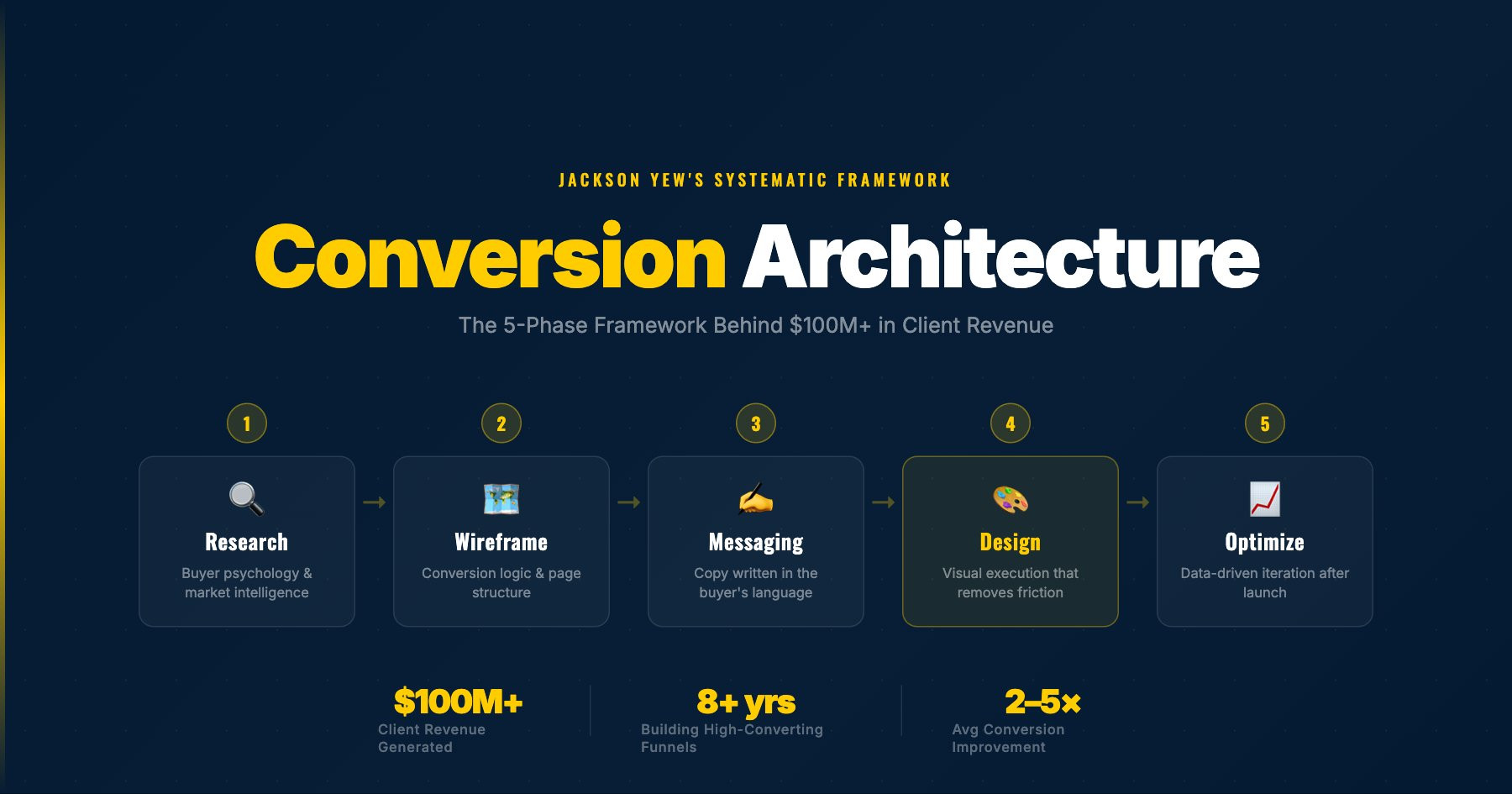
Conversion Architecture is a 5-phase framework for designing funnels that are engineered to convert before a single pixel gets placed.
It's not just about design. It's not just about copy. It's the entire system: how you research your audience, structure your pages, write your messaging, design the experience, and optimize based on real data.
Most funnel builders skip straight to Phase 4 (the visual design) and wonder why their conversion rates are mediocre. Conversion Architecture forces you to do the hard thinking upfront so the design almost builds itself.
Here's the framework:
Phase 1: Research and Intelligence
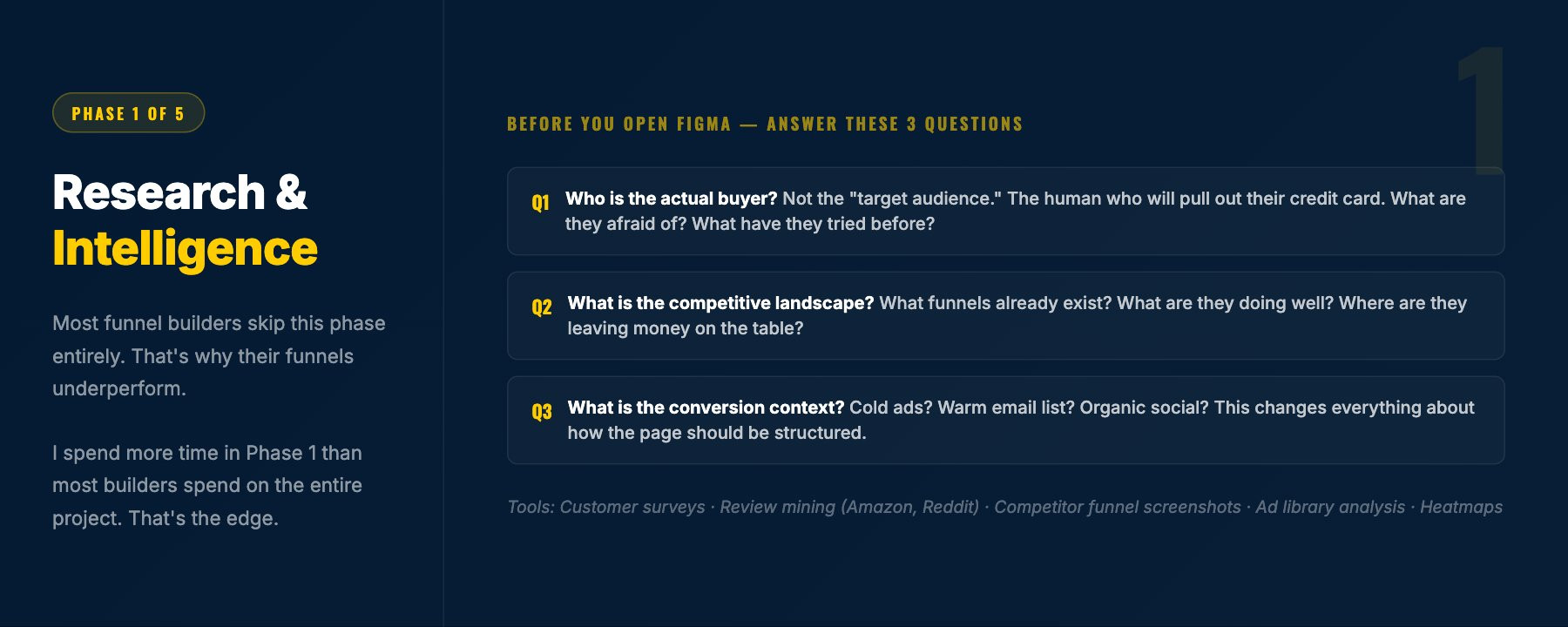
Before you open Figma, before you write a headline, before you do anything, you need to understand three things:
1. Who is the buyer?
Not the "target audience." The actual human being who will pull out their credit card. What are they afraid of? What have they tried before? What language do they use to describe their problem?
2. What is the competitive landscape?
What funnels already exist in this space? What are they doing well? Where are they leaving money on the table?
3. What is the conversion context?
Where is the traffic coming from? Cold ads? Email list? Organic social? This changes everything about how the page should be structured.
I spend more time in this phase than most funnel builders spend on the entire project. That's the edge. When you deeply understand the buyer, the copy writes itself and the design serves the message instead of fighting it.
Tools I use: Customer surveys, review mining (Amazon reviews, Reddit, Skool communities), competitor funnel screenshots, ad library analysis, heatmaps from existing pages.
Phase 2: Structural Wireframing
This is where Conversion Architecture separates from "just build a funnel."
Before any visual design, I map out the entire conversion logic:
- What's the primary action? (Buy, book a call, opt in)
- What objections need to be handled before that action?
- In what order should information be presented?
- Where do we need proof? What kind of proof?
- What's the exit strategy for people who aren't ready?
The wireframe isn't a design mockup. It's a conversion map. Every section exists for a reason. Every section has a job.
I think of it like building a house. You don't start with the paint color. You start with the foundation, the load-bearing walls, the flow between rooms. The architecture comes first. The aesthetics serve the architecture.
A wireframe that answers "why is this section here?" for every block is a wireframe that will convert. A wireframe that just looks like a nice layout is a wireframe that will look pretty and underperform.
Phase 3: Messaging and Copy
Copy is not decoration. It's the engine.
In Conversion Architecture, the copy follows directly from Phase 1 research and Phase 2 structure. You already know:
- What the buyer needs to hear (Phase 1)
- In what order they need to hear it (Phase 2)
So the copy phase is about execution, not ideation. You're not staring at a blank page wondering what to write. You're filling in a proven structure with language your buyer already uses.
Key principles:
- Headlines do the heavy lifting. If the headline doesn't stop the scroll, nothing else matters.
- One idea per section. Don't stack multiple arguments into one block.
- Proof is not optional. Every claim needs evidence: testimonials, data, screenshots, case studies.
- The button text matters more than you think. "Get Instant Access" converts differently than "Buy Now" converts differently than "Start My Free Trial."
The biggest mistake I see: people write copy that sounds like what they want to say instead of what the buyer needs to hear. Phase 1 research fixes this.
Phase 4: Conversion Design
This is what most people think "funnel building" is. But by Phase 4, 80% of the conversion work is already done.
Design in Conversion Architecture serves one purpose: remove friction between the visitor and the action.
That means:
- Visual hierarchy guides the eye. The most important elements are impossible to miss.
- White space is not wasted space. It creates breathing room and prevents cognitive overload.
- Color is strategic. The CTA button should be the most visually dominant element on the page.
- Mobile isn't an afterthought. Over 60% of traffic is mobile. If your funnel doesn't convert on a phone, it doesn't convert.
- Speed kills (slowly). Every second of load time costs conversions. Optimize images, minimize scripts, test on slow connections.
I've seen beautiful funnels that convert at 0.5% and ugly funnels that convert at 12%. The difference is always Phases 1-3. Design amplifies a strong foundation. It cannot rescue a weak one.
Phase 5: Optimize and Iterate
A funnel is never "done." It's live.
After launch, Conversion Architecture shifts to data-driven optimization:
- Heatmaps: Where are people clicking? Where are they dropping off?
- A/B testing: Test headlines first (biggest impact), then CTAs, then page structure.
- Funnel analytics: Track every step. Where is the biggest drop-off? That's where you focus.
- Qualitative feedback: What are people saying in support tickets, comments, DMs? This is Phase 1 research, ongoing.
Most funnels I work on see their biggest conversion improvements in weeks 2-6 after launch. Not because the original was bad, but because real data always reveals something you couldn't predict.
The funnel builders who treat launch day as the finish line are leaving money on the table. The ones who treat it as the starting line are the ones I see hitting 7- and 8-figure numbers.
Why It Works
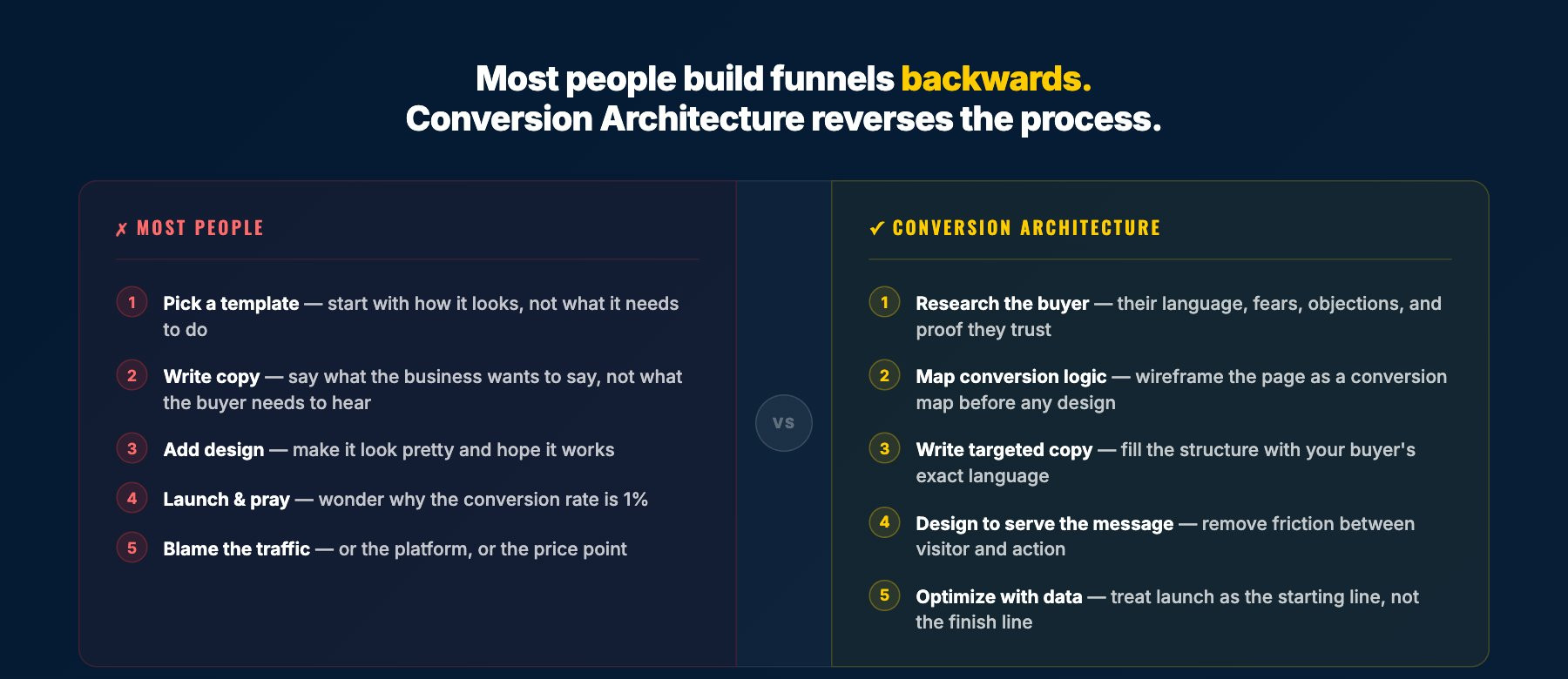
Conversion Architecture works because it reverses the typical funnel-building process.
Most people: Pick a template → Write copy → Add design → Hope it works
Conversion Architecture: Research buyer → Map conversion logic → Write targeted copy → Design to serve the message → Optimize with data
It's the difference between building on assumptions and building on evidence. Every phase feeds the next. Nothing is random.
Over the past 8+ years, this framework has generated over $100M in client revenue across dozens of businesses. Not because it's clever. Because it's systematic.
Who Is Conversion Architecture For?
- Freelance funnel builders who want to charge premium rates and deliver premium results
- Marketing agencies that need a repeatable process for client funnels
- Course creators and coaches building their own sales funnels
- Businesses spending money on ads but not converting traffic
If you've ever built a funnel that "should have worked" but didn't, the issue is almost always in Phases 1-3. The research was thin, the structure was inherited from a template, or the copy was written from the business's perspective instead of the buyer's.
Frequently Asked Questions
How long does Conversion Architecture take?
A full build typically takes 2-4 weeks depending on complexity. Phase 1 (research) alone can take 3-5 days. The upfront investment pays off in conversion rates that justify the time.
Can I apply this to landing pages, not just full funnels?
Yes. Every landing page is a micro-funnel. The same 5 phases apply whether you're building a 7-page funnel or a single opt-in page.
Do I need to be a designer to use this framework?
No. Phases 1-3 are strategic, not visual. If you nail those phases, even a basic design can convert well. That said, strong design in Phase 4 amplifies everything.
What tools do you use?
I primarily build in GoHighLevel for page design, use Hotjar for heatmaps, Google Analytics for funnel tracking, and Figma for wireframing. But the tools are secondary. The framework is platform-agnostic.
What conversion rates should I expect?
It depends on the offer, traffic source, and market. But I've consistently seen 2-5x improvements over template-based funnels when Conversion Architecture is applied properly.
Jackson Yew is a Conversion Design and Funnel Strategist who has built funnels for Frank Kern, Mike Dillard, Dan Lok, and dozens of other 7- and 8-figure businesses. He is the co-founder of Funnel Duo Media and holds a Guinness World Record for the Largest AI Marketing Lesson.