
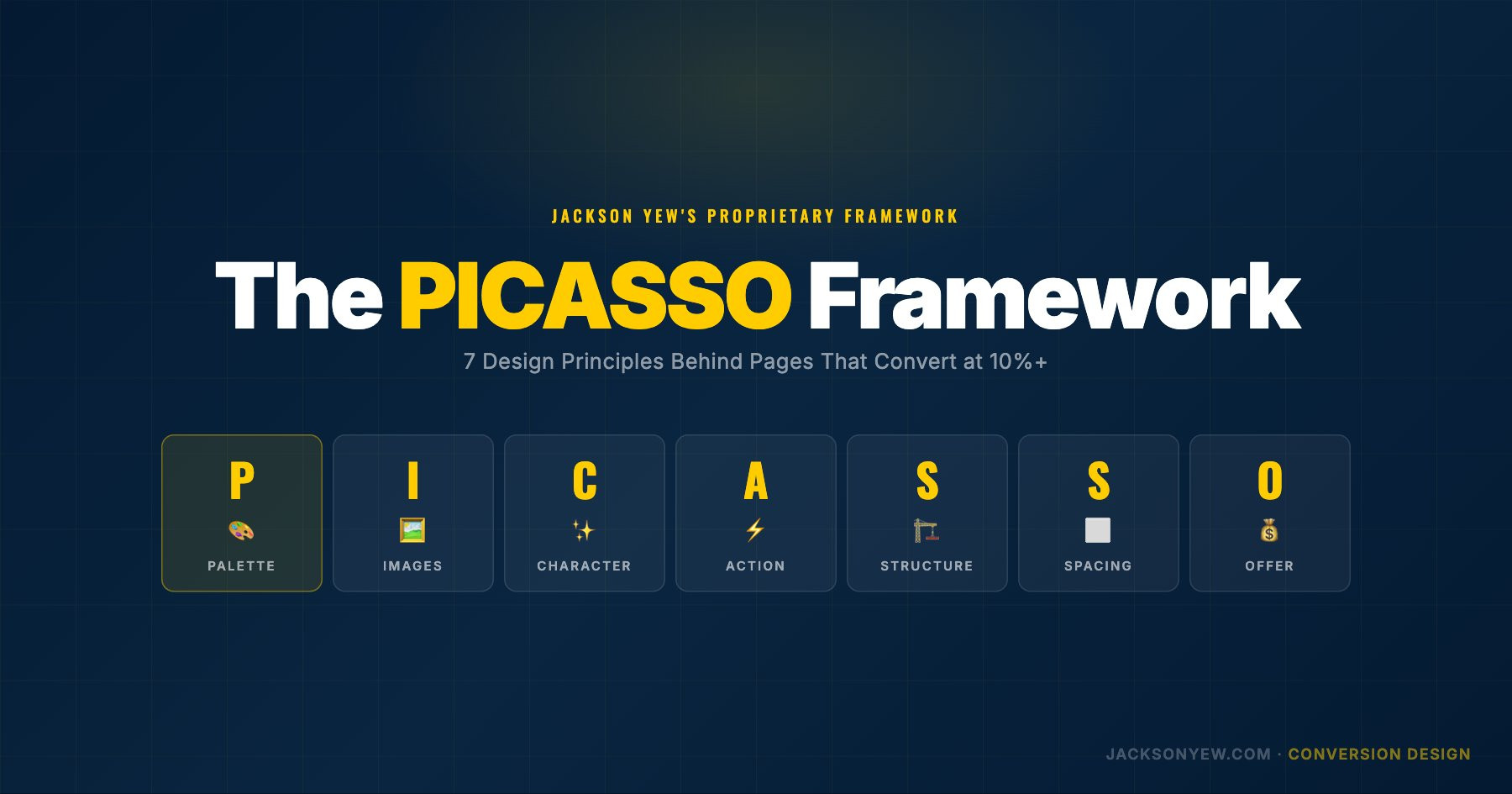
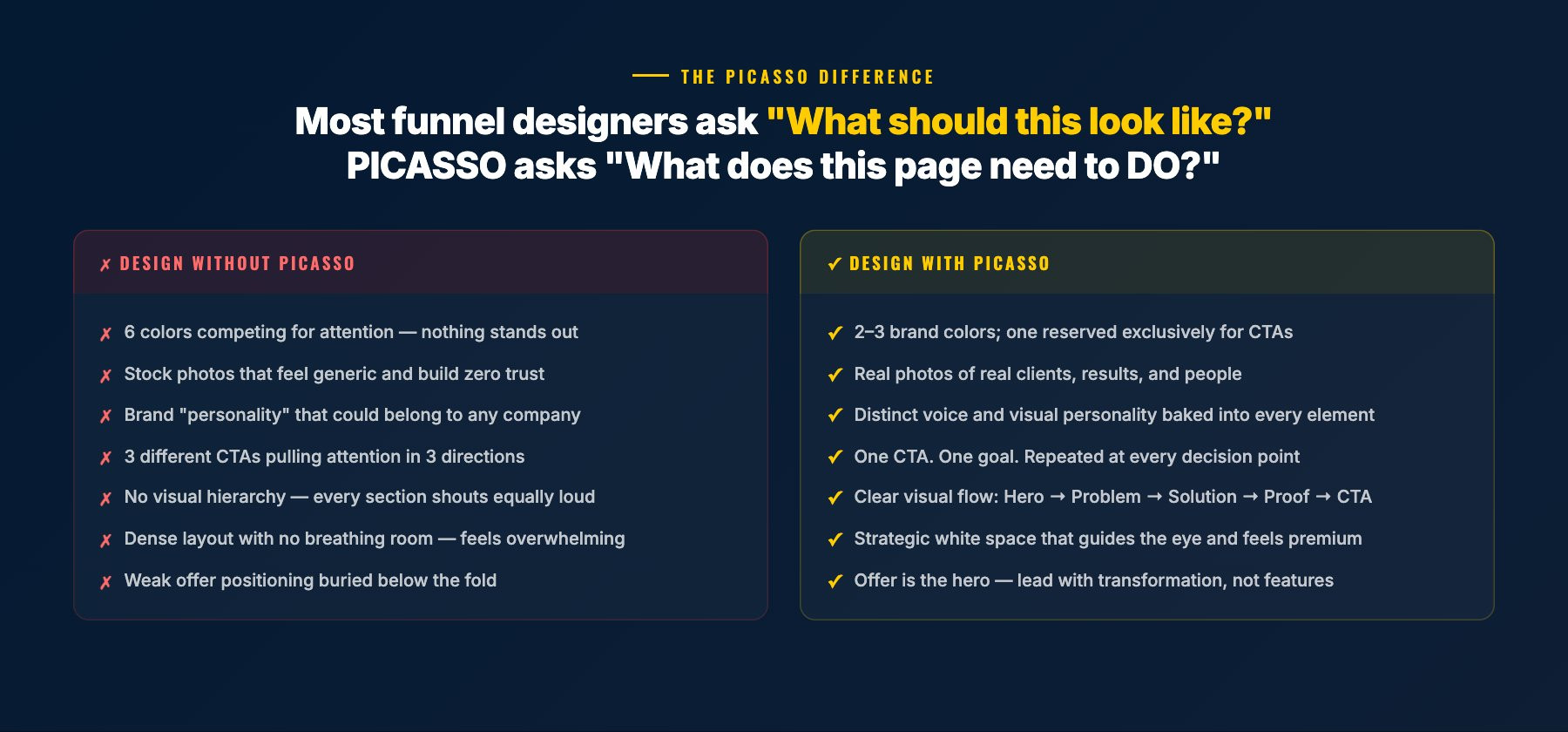
Most funnel designers start with a blank canvas and ask: "What should this look like?"
Wrong question.
After building funnels for Frank Kern, Mike Dillard, Dan Lok, and dozens of other 7- and 8-figure businesses, I realized the right question is: "What does this page need to DO?"
That shift is what led me to create the PICASSO Framework.
Seven principles. One system. Every page I build runs through it. Every student I teach learns it. And the funnels that follow it consistently outperform the ones that don't.
Here's how it works.
What Is the PICASSO Framework?
PICASSO is an acronym for the seven core principles that every high-converting page needs to get right:
- P - Palette
- I - Images
- C - Character
- A - Action
- S - Structure
- S - Spacing
- O - Offer
These aren't abstract design theories. They're a checklist. Before any page I build goes live, it passes through all seven. If one is weak, the page underperforms. Fix that one element, and the numbers move.
Most designers think about aesthetics. PICASSO is about engineering attention, trust, and action through visual decisions.
P - Palette
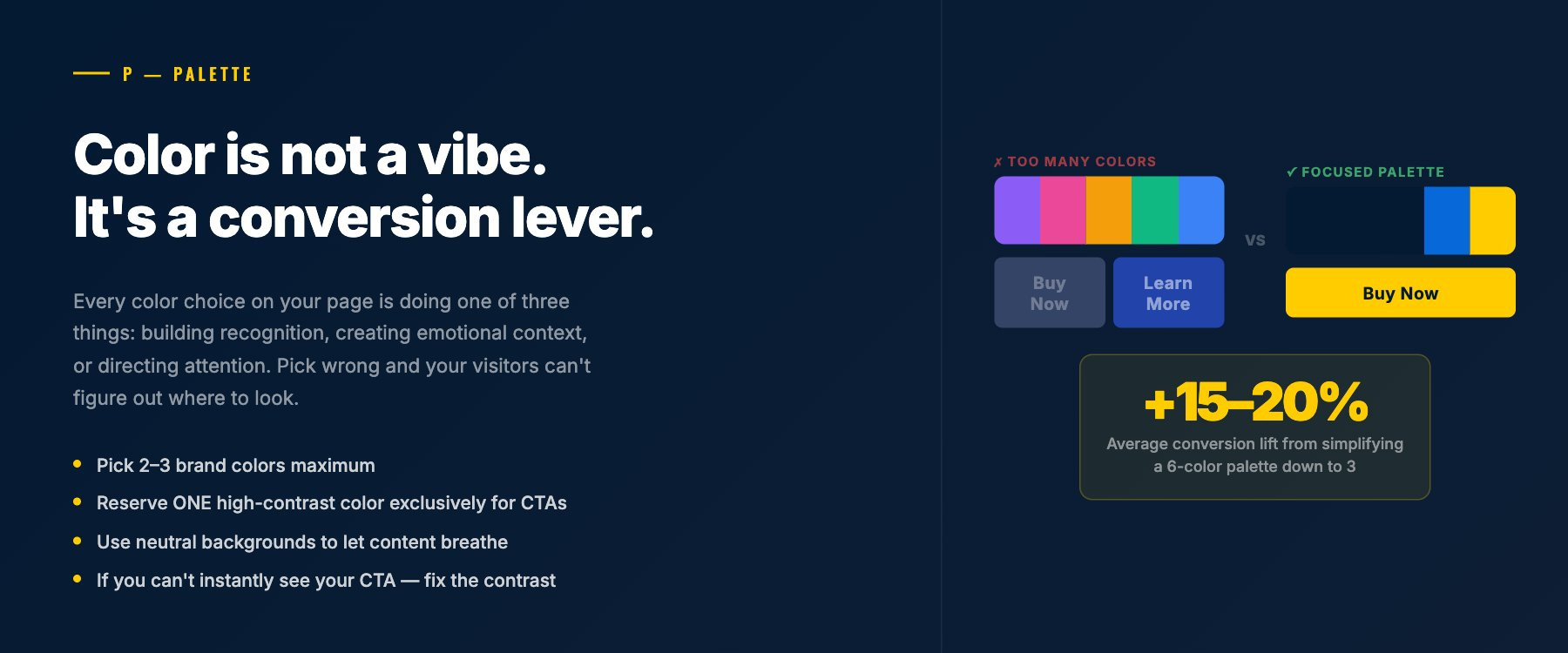
Color is not a vibe. It's a conversion lever.
Your color palette does three things on a landing page:
- Establishes brand recognition in the first 0.5 seconds
- Creates emotional context before the visitor reads a single word
- Directs attention to the elements that matter most
The biggest mistake I see: pages with 5-6 colors competing for attention. The visitor's brain can't process it. Everything looks equally important, which means nothing is important.
The PICASSO approach to Palette:
- Pick 2-3 brand colors maximum
- Reserve one high-contrast color exclusively for CTAs
- Use neutral backgrounds to let content breathe
- Test warm vs. cool tones against your audience (B2B tends to trust cooler palettes; direct-to-consumer responds to warmer ones)
I've watched conversion rates jump 15-20% just by simplifying a palette from six colors to three and making the CTA button the only element using the accent color.
I - Images
Every image on your page is either building trust or creating noise. There is no neutral.
Stock photos of people in suits shaking hands? Noise. A real photo of your client's results? Trust. A polished headshot that looks like it belongs on this page? Trust. A random decorative graphic that doesn't connect to the offer? Noise.
The PICASSO approach to Images:
- Every image must have a job. If you can't explain what it's doing for conversion, remove it
- Real beats stock. Always. Even an imperfect real photo outperforms a perfect stock image
- Product/service screenshots should show the actual thing the visitor is buying
- Faces build trust, but only when they're relevant faces (the founder, the client, the student who got results)
- Image placement follows eye flow. Put proof images near the CTA. Put context images near the headline
The pages that convert best often have fewer images than you'd expect. But every image that's there is working.
C - Character
Character is what makes your page feel like it belongs to someone specific instead of a generic template.
This is where most funnel builders fail. They use the same template as everyone else, swap in their logo and copy, and wonder why it doesn't convert. There's no personality. No signature. No reason for the visitor to feel like they're in the right place.
The PICASSO approach to Character:
- Typography choices carry personality. A bold sans-serif says something different than a refined serif
- Custom elements (icons, illustrations, photo treatments) that match the brand's energy
- Consistency with the brand across every touchpoint. If your Instagram is bold and direct, your funnel shouldn't look soft and corporate
- The page should feel like an extension of the person or brand behind it. If someone lands here from your social media, the transition should feel seamless
Character is not about being flashy. It's about being recognizable. When a visitor lands on your page, character is the reason they think "this feels right" before they've read a word.
A - Action
Every page exists to drive one action. One.
Not three actions. Not "learn more AND sign up AND follow us AND download this." One primary conversion goal.
The PICASSO approach to Action:
- Define the single most important action before you design anything
- The CTA button for that action should be the most visually dominant element on the page
- Repeat the CTA at natural decision points (after the headline, after social proof, after objection handling, at the bottom)
- Button copy should be specific, not generic. "Get My Free Funnel Audit" beats "Submit." "Start My 30-Day Trial" beats "Sign Up"
- Remove or minimize secondary actions that compete. Every link that isn't your primary CTA is a potential exit
I've audited hundreds of funnels where the page had great copy, great design, great offer... and three different CTAs competing with each other. Simplify to one action, and the conversion math changes immediately.
S - Structure
Structure is the invisible architecture of your page. The visitor never notices it. But they feel it.
A well-structured page guides the visitor through a logical sequence: attention, interest, desire, action. A poorly structured page dumps information randomly and hopes something sticks.
The PICASSO approach to Structure:
- Hero section: Hook + value proposition + primary CTA (above the fold)
- Problem section: Agitate the pain point the visitor already feels
- Solution section: Position your offer as the answer
- Proof section: Testimonials, case studies, numbers, logos
- Objection handling: Address the top 3 reasons someone would say no
- Final CTA: Repeat the offer with urgency or scarcity if applicable
This sequence isn't random. It maps to how buying decisions actually work in the brain. You earn attention first, build trust second, handle objections third, and ask for the action last.
Most pages I audit have the right content in the wrong order. Moving the testimonials from the bottom to right below the hero has doubled conversion rates for some of my clients.
S - Spacing
Spacing is the most underrated conversion lever in design.
Cramped pages feel desperate. Cluttered pages feel overwhelming. Both kill trust before the visitor has a chance to engage with your message.
The PICASSO approach to Spacing:
- White space is not wasted space. It's breathing room for the brain
- Each section should have clear visual separation from the next
- Text blocks should never be wider than 60-70 characters per line (readability drops sharply beyond that)
- Padding around CTAs matters. Give your button room to stand out. A button squeezed between two text blocks gets lost
- Mobile spacing requires its own treatment. What looks great on desktop often becomes cramped on a phone screen
The test is simple: if a section feels "busy" when you squint at it, the spacing is wrong. The visitor's eye should flow naturally from one element to the next without feeling overwhelmed at any point.
O - Offer
This is the one that most designers forget is their problem too.
"But the offer is the client's job, not mine." Wrong. If the offer isn't clear on the page, the design failed.
The PICASSO approach to Offer:
- The offer must be instantly understandable. If a visitor can't explain what they're getting in one sentence after 5 seconds on the page, the offer presentation is broken
- Visual hierarchy should make the offer elements obvious: what you get, what it costs (if applicable), what happens next
- Stack the value visually. Show everything included. Make it feel like a lot
- Risk reversal (guarantees, free trials, money-back) should be visually prominent, not buried in fine print
- The offer section should feel like the natural conclusion of everything above it. If the structure did its job, the visitor arrives at the offer already wanting to say yes
The design of the offer section is where trust converts to action. Get this wrong and everything above it was wasted.
How to Use the PICASSO Framework
PICASSO is a checklist, not a sequence.
When I build a funnel, I don't go P-I-C-A-S-S-O in order. I design the page, then audit it against all seven principles. Each one gets a pass/fail. If any element is weak, I fix it before the page goes live.
Here's how I recommend using it:
- Build your first draft based on the copy and structure
- Run the PICASSO audit on the completed page
- Score each principle on a 1-5 scale
- Fix anything below a 3 before launch
- Re-audit after launch data comes in (heatmaps, scroll depth, conversion rate)
The frameworks that work are the ones you actually use. PICASSO works because it's simple enough to remember, comprehensive enough to catch problems, and specific enough to generate actionable fixes.
FAQ
What does PICASSO stand for in funnel design?
PICASSO stands for Palette, Images, Character, Action, Structure, Spacing, and Offer. It's a 7-principle design framework created by Jackson Yew for building high-converting landing pages and funnels.
Who created the PICASSO Framework?
Jackson Yew, a conversion design specialist and funnel strategist who has built funnels for clients including Frank Kern, Mike Dillard, and Dan Lok, generating over $100M in client revenue.
Is the PICASSO Framework only for landing pages?
No. While it was developed for funnel pages, the seven principles apply to any page designed to drive a specific action: sales pages, opt-in pages, webinar registration pages, e-commerce product pages, and more.
How is PICASSO different from general design principles?
General design principles optimize for aesthetics. PICASSO optimizes for conversion. Every principle in the framework is evaluated based on whether it moves the visitor closer to taking action, not whether it looks good in a portfolio.
Can I use PICASSO with any design tool?
Yes. PICASSO is tool-agnostic. Whether you design in Figma, Canva, GoHighLevel, WordPress, or Webflow, the seven principles apply to the output, not the tool.
Jackson Yew is a conversion design specialist and funnel strategist. He has built funnels for Frank Kern, Mike Dillard, Dan Lok, and dozens of other industry leaders, generating over $100 million in client revenue. He teaches the PICASSO Framework and Conversion Architecture through his courses and coaching programs.