
Key takeaway
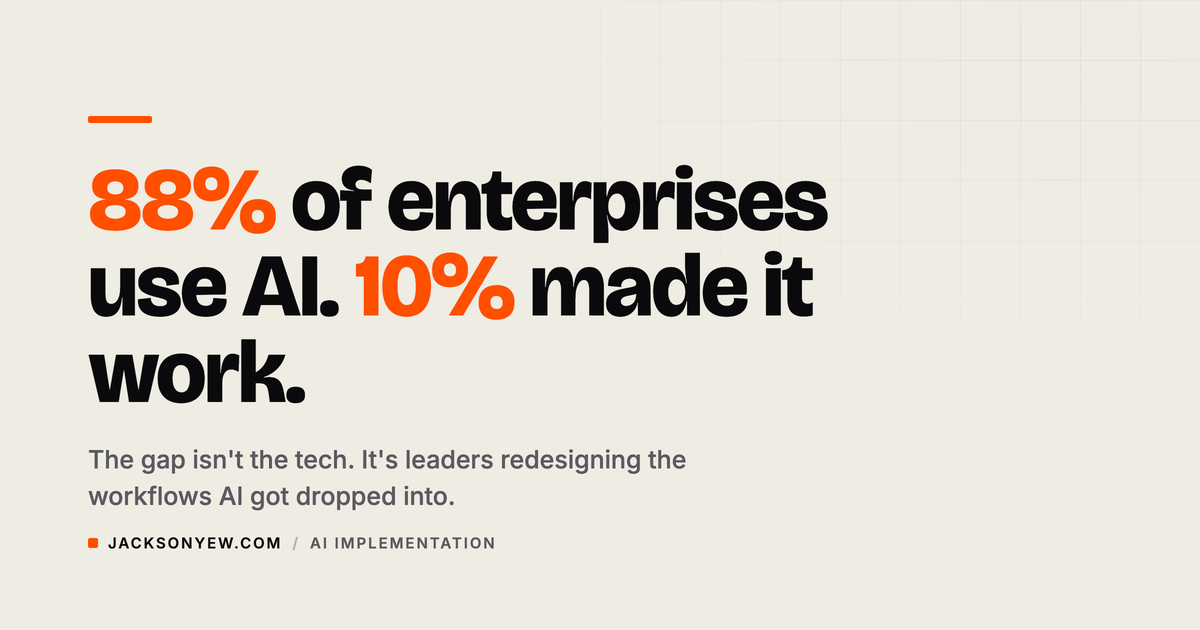
Most enterprises now use AI somewhere, but fewer than 10% have fully scaled it — and the gap is leadership redesigning the workflows AI was dropped into, not the technology itself.
Updated : Refreshed source citations, internal links, and formatting throughout.
The number that gets cited in every boardroom deck right now is 88%. That is the share of organizations that now use AI in at least one business function, according to Stanford's 2026 AI Index, drawing on McKinsey's State of AI survey.
The number that should be cited is 10%. That is the share that has fully scaled AI in even a single business function, according to Stanford's 2026 AI Index.
The gap between those two numbers is the defining strategic problem of 2026.
The Deployment Headline Is Misleading
When 88% of organizations say they deploy AI, the instinct is to treat adoption as a solved problem. Boards hear 88% and assume progress. Investors hear 88% and assume returns.
The deeper data tells a different story.
Fewer than one in ten organizations have fully scaled AI in any single business function. Not marginal scale. Not partial scale. Full deployment that actually changes how a function operates remains rare.
That means the overwhelming majority of organizations running AI cannot point to a function it has genuinely transformed. They have the tools. They have the spend. They have the internal announcements. What they do not have is scaled value.
This is not an adoption problem. It is an implementation theater problem. Organizations checked the box on deployment without solving for the thing deployment was supposed to deliver.
Why Most Companies Stall After Deployment
Deloitte's 2026 State of AI in the Enterprise report surfaces a specific structural reason: 84% of companies have not redesigned jobs around AI capabilities.
Read that again. Nearly nine out of ten enterprises deployed AI into workflows that were designed for humans working without AI. They added a faster engine to the same horse cart and wondered why it did not become a car.
This is the pattern that separates pilot programs from scaled operations. Deployment without workflow redesign produces a narrow set of outcomes: some tasks get faster, some reports get automated, some meetings get shorter. But the organizational system itself does not change.
The 10% who have scaled value did something different. They treated AI not as a tool to add to existing jobs, but as a reason to rethink what those jobs should look like in the first place.
That requires a different kind of leadership decision. Not "which AI vendor do we buy?" but "which workflows should not exist in their current form?"
What the 10% Actually Did
Deloitte's research identifies a clear pattern among the organizations scaling AI value:
They redesigned workflows before deploying tools. Instead of layering AI onto existing processes, they mapped the end-to-end workflow, identified where AI changes the logic of the work, and rebuilt the process around that new logic. This is harder than buying software. It is also the only approach that compounds.
They treated AI as a strategic function, not an IT project. In the organizations seeing scaled returns, AI sits at the executive level. It is a C-suite agenda item with business outcome ownership, not a technology initiative managed by the IT department and reported on quarterly.
They expanded workforce access aggressively. Companies have broadened workforce AI access by 50% in a single year, from under 40% to roughly 60% of workers with sanctioned AI tools. The 10% did not limit AI to a specialized team. They pushed access across the organization and built the training infrastructure to support it.
85% of companies now expect to customize AI agents for their operations. The organizations that already redesigned their workflows will be ready to deploy those agents into systems built for them. The organizations that did not will be deploying agents into the same unchanged processes that failed to produce value the first time.
The Leadership Question
The gap between 88% and 10% is not a technology gap. The tools are available to everyone. The pricing is competitive. The vendor landscape is mature enough that no organization is locked out of access.
The gap is a leadership gap.
It is the difference between a CEO who asks "are we using AI?" and one who asks "have we changed how work gets done because of AI?"
The first question gets answered with a deployment metric. The second question gets answered with a revenue line.
For business leaders evaluating their AI strategy in 2026, the honest starting point is not whether AI is deployed. It is whether anyone redesigned the system it was deployed into.
If the answer is no, the 88% number is not progress. It is overhead.
Related: how Jackson runs AI agents as an executive team and work with Jackson on AI systems.
FAQ
Why do most companies show no financial return on AI even after deploying it?
Deloitte's data shows 56% of surveyed companies captured neither revenue gains nor cost savings from their AI investments. The reason is structural: 84% deployed AI into workflows that were still designed for humans working without it. Faster tools layered onto unchanged processes do not produce a financial outcome.
What did the 10% of companies that scaled AI value do differently?
They redesigned workflows before deploying tools, mapping the end-to-end process and rebuilding it around where AI changes the logic of the work. They also treated AI as a C-suite function with business outcome ownership rather than an IT project, and they expanded sanctioned AI access aggressively, growing workforce access by 50% in a single year.
How do I tell if my company's AI rollout is real progress or just deployment theater?
Ask whether anyone redesigned the system the AI was deployed into, not just whether AI is in use. A CEO who asks 'are we using AI?' gets a deployment metric back. A CEO who asks 'have we changed how work gets done because of AI?' gets a revenue line. If no workflow was rethought, the deployment is overhead.
Should I deploy AI agents into my existing processes if they already run fine?
Deploying agents into unchanged processes repeats the mistake that produced no value the first time. 85% of companies now expect to customize AI agents for their operations, but only the ones that already redesigned their workflows will be deploying those agents into systems built for them. Fix the workflow logic before adding the agent.
Sources
- The State of AI in the Enterprise - 2026 AI report Deloitte · January 1, 2026
- From Ambition to Activation: Organizations Stand at the Untapped Edge of AI's Potential, Reveals Deloitte Survey (press release) Deloitte · January 1, 2026
- The 2026 AI Index Report Stanford HAI (Institute for Human-Centered AI) · April 13, 2026