
Key takeaway
Follower counts no longer predict revenue; businesses in 2026 are built on owned, engaged audiences such as newsletters and paid communities, where active collaborators convert and retain far better than passive followers.
Updated : Refreshed source citations, internal links, and formatting throughout.
Chasing followers in 2026 is like chasing MySpace friends in 2010.
The metric changed. The game changed. Most people didn't get the memo.
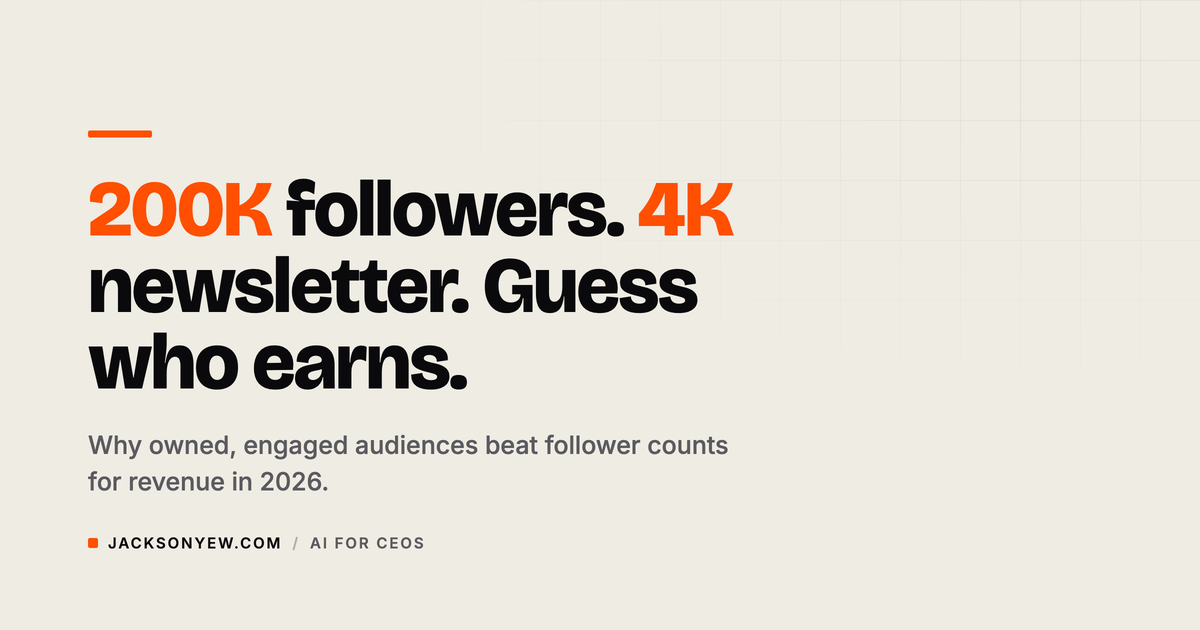
I have a creator friend who has 200,000 Instagram followers and consistently struggles to generate $5,000 in a month from that audience. I have another friend with a 4,000-person newsletter and a private community of 80 paid members at $300 a month. He cleared $24,000 last month without a launch or a viral moment.
The difference is not content quality. It is not strategy sophistication. It is the metric they built toward.
One built a following. One built an audience.
They are not the same thing.
Why follower counts stopped predicting anything
Followers are a reach metric. They tell you how many accounts have technically said "show me more of this." They do not tell you whether those accounts are paying attention, whether they trust you, whether they will buy anything, or whether they would notice if you stopped posting.
Follower counts have been decoupled from actual reach for years. LinkedIn median impressions per post dropped 47% between June 2024 and May 2025, according to AuthoredUp's study of roughly 3 million posts. Instagram organic reach for brand accounts has been in structural decline since 2018. TikTok reach is high but notoriously disconnected from purchasing behavior for most categories.
1 in 3 consumers now uses social media to discover new products and brands -- and the platforms capturing that attention (TikTok, Instagram, YouTube) are also the platforms where a massive following generates far less reliable business impact than a small, engaged, owned audience.
The shift replacing the follower economy has a name: the collaborator economy. Audiences in 2026 do not want to consume content from accounts they follow. They want to co-create, co-own, and actively participate. The platforms and formats that reward this -- communities, newsletters, collaborative content, DM conversations -- are outperforming passive follower accumulation on every metric that connects to business outcomes.
What "active collaborator" actually means
The collaborator economy is not a trend. It is a fundamental shift in what audiences are willing to exchange attention for.
Passive following is free. It costs the audience nothing -- no attention, no participation, no skin in the game. The account posts. The follower scrolls past or stops for a moment. The transaction is one-way and shallow.
Active collaboration is valuable. When someone co-creates with you -- submits a question you answer publicly, contributes to a community discussion, votes on a product direction, shares their own story in response to yours -- they have invested something. They have skin in the game.
The economic consequence: active collaborators convert to paying customers at dramatically higher rates than passive followers. They stay as customers longer. They refer others. The relationship has depth that follower counts cannot measure.
StoryChief's Social Media Algorithms 2026 data shows that platform algorithms in 2026 are increasingly rewarding content that generates depth of engagement (saves, DM shares, long comments, replies) over breadth of engagement (likes, shallow comments). The platforms are moving in the same direction as business outcomes: depth over scale.
Owned audiences outperform rented audiences on every business metric
The framework I use is simple: rented audiences and owned audiences.
Rented audiences are followers on platforms you do not control. The platform can change the algorithm, reduce your reach, suspend your account, or cease to exist. Your follower count is an asset held in someone else's custody.
Owned audiences are subscribers on platforms you control -- a newsletter list, a private community, a SMS list. You can take these with you. No platform can reduce your reach to them. No algorithm decides whether your message gets delivered.
Rented audiences are worth building because distribution matters. But they are not the business. They are a discovery mechanism.
The business is what happens when a rented audience subscriber becomes an owned audience subscriber -- when a follower becomes a newsletter reader, a community member, or a direct conversation.
That transition is the moment the relationship shifts from platform-dependent to personal. And the businesses built on owned audiences are structurally more defensible, more monetizable, and less subject to the quarterly algorithm anxiety that characterizes most social-media-dependent businesses.
A 4-step framework for converting followers to collaborators
Here is what I have found actually moves the needle:
Step 1: Ask questions that require thought, not just a click. "What is your biggest challenge with X right now?" generates different responses than "Drop a fire emoji if you agree." The question that requires thought from the respondent is the one that identifies who in your audience is paying genuine attention. These are your collaborators.
Step 2: Involve your audience in decisions. I started asking my audience to weigh in on content topics, product ideas, and strategic questions. Not as a consultation exercise -- as genuine input that influenced real decisions. When people see their input reflected in your output, the relationship deepens. They become co-creators of something they have partial ownership over.
Step 3: Credit community input publicly. When an audience question shapes a post, say so. When a community member's experience becomes a case study, credit them. Visible attribution creates a feedback loop: people see that contributing gets recognized, so more people contribute. The community becomes generative rather than passive.
Step 4: Build a paid inner circle. The deepest collaborators want a paid relationship. Not because they need to pay -- because paying signals commitment and creates a different quality of interaction. A community at $50 to $200 a month that contains 100 engaged people is a more valuable business asset than 100,000 followers who scroll past without registering.
The number that matters now
One metric I use that matters more than follower count: response rate to my newsletter.
When I send an email to my list and ask a question, what percentage replies? That number tells me more about the health of my business relationship with my audience than my Instagram follower count, my TikTok views, or my LinkedIn connection number combined.
The businesses being built in 2026 that will still be standing in 2030 are the ones built on owned, engaged audiences. Not the ones with the biggest rented follower counts.
Chase the relationship. The metric will follow.
Related: Jackson's story and work with Jackson.
FAQ
Why have follower counts stopped predicting revenue?
Followers are a reach metric. They tell you how many accounts technically asked for more of your content, not whether those accounts trust you or will buy anything. Follower counts have been decoupled from actual reach for years, and a small engaged owned audience now generates far more reliable business impact than a large following.
What is the difference between a rented audience and an owned audience?
A rented audience is followers on platforms you do not control, where the algorithm can cut your reach or the account can be suspended. An owned audience is subscribers you control, like a newsletter list, private community, or SMS list, that you can take with you. Rented audiences are a discovery mechanism. Owned audiences are the business.
How do I actually turn passive followers into active collaborators?
Four moves: ask questions that require thought instead of a click, involve your audience in real decisions, credit their input publicly so contributing gets recognized, and build a paid inner circle. Paying signals commitment and creates a different quality of interaction, which is why a 100-person community at $50 to $200 a month outperforms 100,000 passive followers.
What single metric is worth tracking instead of follower count?
Newsletter response rate. When you email your list and ask a question, what percentage replies? That number reveals more about the health of your business relationship with your audience than Instagram followers, TikTok views, and LinkedIn connections combined.
Sources
- Vanishing Audience: LinkedIn reach study (3M posts, June 2024-May 2025) AuthoredUp · July 9, 2025
- Instagram Organic Reach in Decline: How to Improve? Predis.ai · January 1, 2025
- Social Media Algorithms 2026: What Marketers Need to Know StoryChief · January 1, 2026
- The 18 social media trends to shape your 2026 strategy (Hootsuite Social Trends 2026) Hootsuite · October 1, 2025
- The creator economy could approach half-a-trillion dollars by 2027 Goldman Sachs Research · April 19, 2023