
Key takeaway
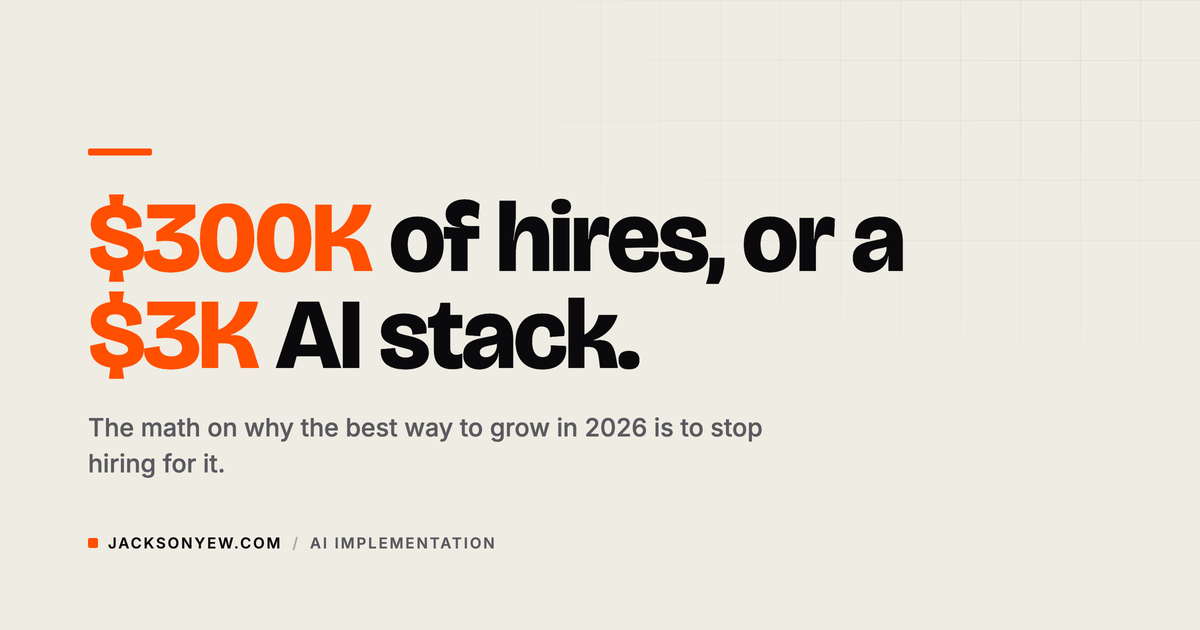
A full AI tool stack costs a few thousand dollars a year and can absorb work that would otherwise cost well over $300,000 in salaried hires.
Updated : Refreshed source citations, internal links, and formatting throughout.
The best way to grow your business in 2026 is to stop hiring for it.
That is not a hot take. It is math.
I have watched founders hire their way into complexity they cannot manage. More people, more meetings, more payroll, more risk. And now we have AI tools that handle a large share of what those people were doing, at a fraction of the cost.
The Numbers First
A full-time copywriter costs $50,000 to $80,000 a year. Claude or Jasper handles first drafts, research, variations, ad copy, and email sequences for under $500 a year. That is not an estimate. That is what I pay.
A social media manager costs $40,000 to $60,000 a year. Metricool with AI scheduling and content suggestions? Around $240 a year.
Customer support rep: $35,000 to $50,000 a year. Intercom's Fin AI? Priced per resolution, and Intercom reports an aggregate automation rate of roughly 67% of tickets.
Bookkeeper: $30,000 to $45,000 a year. Keeper handles the same job at a fraction of that cost for most small businesses.
Research analyst: $45,000 to $70,000 a year. Perplexity Pro and a few hours of your own thinking? $200 a year.
PrometAI puts the total cost of running a solopreneur AI stack at $3,000 to $12,000 per year. That same stack replaces roles that would cost well over $300,000 in annual salary. A 95% to 98% cost reduction.
The U.S. Chamber of Commerce's 2025 Empowering Small Business report found 58% of small businesses now use generative AI, up from 40% in 2024. And according to the SMB Group, 16% of SMBs have already replaced jobs with AI, with 25% expecting to do so within 12 months.
This is not theoretical. It is already happening.
What This Actually Means for How You Build
I hired a copywriter in 2022. Good person. Two weeks to onboard. Another two weeks before the quality got consistent. Three months before I trusted them with anything client-facing. And even then, I was reviewing everything.
I replaced that workflow with AI in 2024. Not the person. The workflow.
The AI draft is ready in 4 minutes. I review, edit, and publish. Total time: 20 minutes instead of 3 hours.
That is not about being cheap. It is about speed and control.
The bottleneck in my business was never budget. It was the gap between having an idea and executing it. AI collapsed that gap.
What AI Still Cannot Replace
AI does not have taste. It does not know when something is off-brand in a way that will confuse your audience. It does not know which client relationships matter most and why. It does not sense the room in a sales call. It does not make judgment calls when the answer is not in any framework.
Positioning is yours. The decision about what your business stands for, who you are for, what you will not do. That is yours. AI will optimize whatever you give it. If you give it a wrong premise, it will optimize the wrong thing very efficiently.
Relationships are yours. The trust you have built with clients, partners, your audience. AI can help you communicate. It cannot build the relationship.
Your specific point of view is yours. The one thing that makes your content, your offers, and your brand different is you. AI can sound like you. It cannot be you.
This is where the leverage actually lives. You stop doing the work AI can do so you can do more of what only you can do.
The AI Role Audit: How to Map Your Business in One Afternoon
Step 1: List every function in your business. Not broad categories. Granular. Content creation. Email. Customer support. Research. Scheduling. Bookkeeping. Proposals. Social media. Ad copy. Video editing. SEO. List them all.
Step 2: For each function, ask one question. "Does this require my specific judgment, relationships, or taste?" If yes, it stays with you. If no, it is a candidate for AI replacement or augmentation.
Step 3: Match each candidate to a tool. Most have one. Claude for writing. Perplexity for research. Zapier for automation. Intercom for support. Keeper for bookkeeping. Metricool for social.
Step 4: Calculate the gap. What are you currently paying, in money or time, for each function? What does the AI alternative cost? That gap is your opportunity. Most founders find a meaningful share of their operational load can shift to AI tools.
Step 5: Decide what to do with the freed capacity. This is the step most people skip. Freed capacity does not automatically become leverage. You have to decide what you are putting it toward.
The last hire you ever need to make is the one who sets up your AI stack. After that, the only irreplaceable person in your business is you.
If you want help mapping your business to an AI stack, book a call with my team. We have done this for dozens of founders and it is a different conversation once you see the numbers on paper.
Related: Conversion Architecture and work with Jackson on business systems.
Jackson
FAQ
What does a full solopreneur AI stack actually cost compared to hiring?
PrometAI puts a full solopreneur AI stack at $3,000 to $12,000 per year. That same stack covers roles that would cost $200,000 to $300,000 in annual salary, a 95% to 98% cost reduction. For example, a copywriter runs $50,000 to $80,000 a year, while Claude or Jasper handles first drafts, research, variations, ad copy, and email sequences for under $500.
How do I decide which functions to keep and which to hand to AI?
For each function in your business, ask one question: does this require my specific judgment, relationships, or taste? If yes, it stays with you. If no, it is a candidate for AI replacement or augmentation. Run that test across every granular function, not broad categories, so content, email, research, scheduling, and bookkeeping each get evaluated on their own.
What can AI not replace in a business?
AI has no taste, so it cannot tell when something is off-brand in a way that confuses your audience. It cannot build relationships or sense the room on a sales call, and it cannot make judgment calls when the answer is not in any framework. Positioning, relationships, and your specific point of view stay with you. AI will optimize whatever premise you give it, including a wrong one.
After AI frees up capacity, what do I do with it?
This is the step most founders skip. Freed capacity does not automatically become leverage. You have to consciously decide what you are putting it toward, usually more of the work only you can do: positioning, relationships, and your point of view. Without that decision, the time just gets reabsorbed by busywork.
Sources
- U.S. Chamber's Latest 'Empowering Small Business' Report Shows Majority of Businesses in All 50 States Are Embracing AI U.S. Chamber of Commerce · August 18, 2025
- How SMBs Are Adopting AI - And What Comes Next (SMB Group, sponsored by Workday) SMB Group / Laurie McCabe's Blog · August 18, 2025
- The Rise of the Solopreneur Tech Stack in 2026 PrometAI · January 25, 2026
- Fin AI Agent automation rate Intercom · January 1, 2026
- Perplexity Pro pricing Perplexity · May 1, 2026
- Metricool Pricing Metricool · May 1, 2026